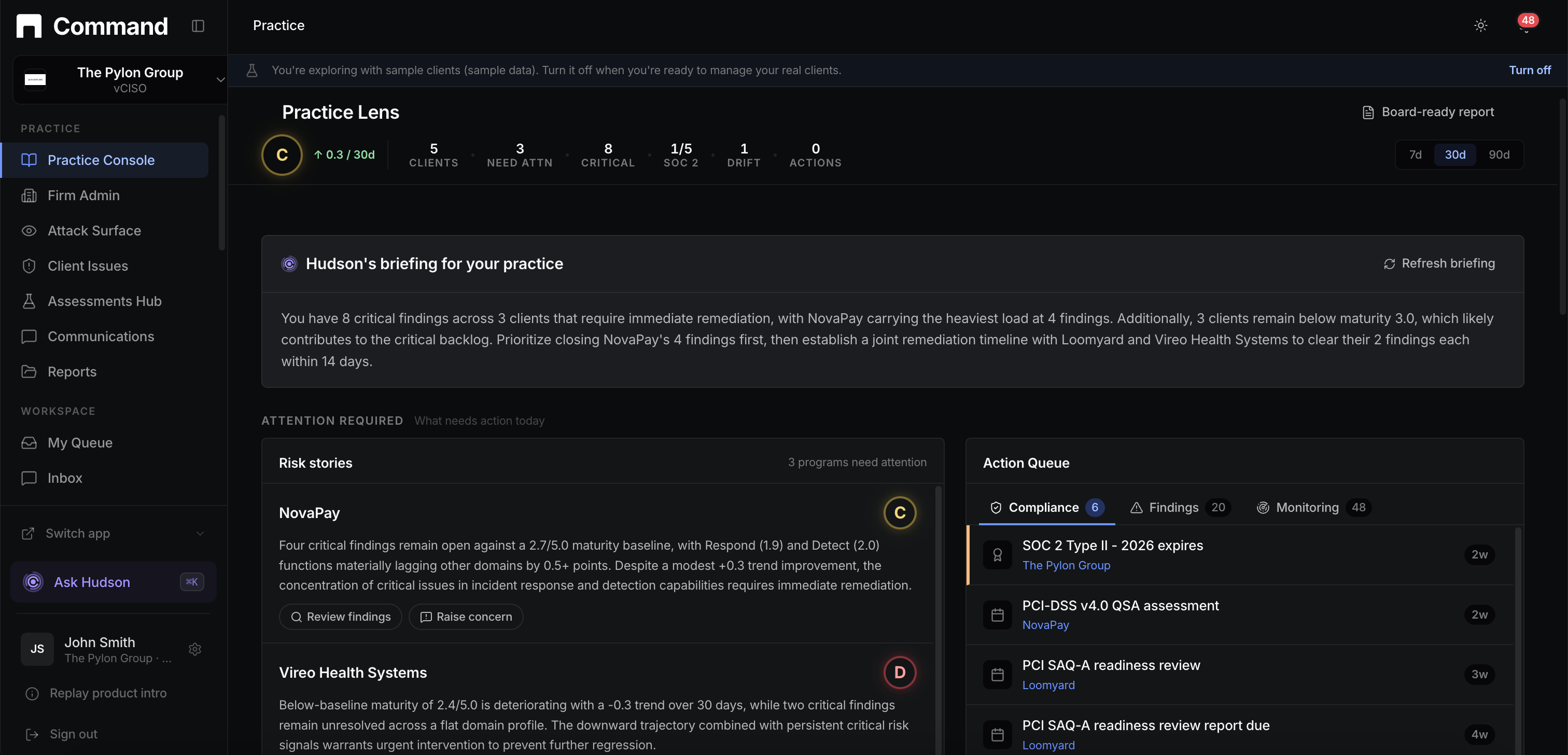
A dozen clients means a dozen spreadsheets. Status gets re-derived by hand the night before every QBR, and the program that is slipping hides in a tab nobody opened. The Practice Console keeps every client's program live in one place, with the one that needs you today already at the top.
Every client's program,
side by side.
Maturity, 30-day trend, open criticals and audit status on one screen, normalized so a 3.2 at one client means the same thing as a 3.2 at another. Sorted by what is slipping, not alphabetically.
 Practice Console › Client book
The QBR narrative,
already written.
Hudson reads every assessment, finding, trend and peer benchmark for each program, then writes the story in plain English. Not a score with no explanation. The paragraph you were going to have to write yourself on Sunday night.
Practice Console › Risk storiesFour critical findings are still open and the program sits at 2.7 out of 5, below where it should be for a SOC 2 commitment. Detection and response are the weakest areas, and nothing has improved in the last 30 days. This one needs attention before the next client review.
Vireo is going backwards. The program slipped 0.3 points last month to 2.4 out of 5, with two criticals still open. Every domain is weak in the same way, so this is a broad capability gap rather than a one-off.
Go deeper
on any signal.
Four questions come up in every practice: who is behind on which framework, what work is rotting in a client backlog, what the outside world can see, and who moved this month. All four read across the whole book, not one client at a time.
Practice Console › Framework coverageCoverage, every framework, every clientOne matrix of how far each client has gotten against everything they are held to, so the gap stands out without opening a file.
Practice Console › Action queueThe overdue work, across the bookEvery overdue finding from every client in one queue, ranked by age, so nothing rots in a backlog you do not open weekly.
Practice Console › External monitoringWhat the outside world seesContinuous external scans on every program: SSL, headers, DNS, email posture and breach signals, scored and tracked without touching the client's network.
Practice Console › Risk moversWho moved, this monthMomentum surfaced on its own, so a slipping program is visible weeks before the review, not at it.
The assessment
that writes itself.
Walk any client's framework out loud on the call you were already having. Command transcribes, drafts the status and maturity for every control, and pulls the evidence it already holds. You review instead of type, and the report is done when the call ends.
NovaPay › SOC 2 › CC6.1 Access controlsHow do you manage and review access to production systems?
Access is provisioned through Okta with role-based groups, and we run a quarterly access review with system owners.
Is the quarterly review documented anywhere?
Yes, the Q2 review is signed off in Command with the owner attestations
Ambient capture · nobody is taking notes
Access is provisioned via Okta with role-based groups. A quarterly access review is performed with system owners and signed off in Command with owner attestations.
Same record.
Different chair.
The Practice Console is one of three seats on the same program model. Nothing is rebuilt when a client grows into their own team, or when a sponsor wants the portfolio view.
The in-house program
One company, one program, one team. The loop, the record, and a board brief that is current because it was never assembled by hand.
Command overview → Seat 03The PE portfolio
Every holding on one scorecard. Each company runs its own program; the sponsor sees all of them, and the portfolio security deck builds itself on demand.
For PE portfolios →Bring your book.
We will run it.
Tell us how many clients you carry and which frameworks they are held to. We will walk through what your book looks like in the Practice Console, with your material rather than a demo tenant.