 Okta
OktaYour program already exists. It is just scattered across a controls spreadsheet, a findings tracker, a roadmap deck and four people's inboxes. Command does not ask you to build a program. It gives the one you have a single place to live, and a memory that survives the quarter.
§ 01The loop
Walk the loop.
Every screen connects.
Connections feed the record. Strategy sets what the record is for. Assessment tests the controls, and the controls show how ready you are for the next audit. Gaps become findings, findings become projects, projects move maturity, and maturity moves the risk position. Metrics measure all of it and set the next quarter's plan. In most stacks those are separate tools joined by exports. Here they are one record, and each step already knows what the last one found.
 Command › Connections
Attack surfaceOperationsConnectionsTechnology
 AWSAmazon Web ServicesActiveFeeds 22 controls2 findingsLast synced Jul 24, 11:00 PM
 EntraMicrosoft Entra IDActiveFeeds 18 controls1 findingsLast synced Jul 24, 11:00 PM
 WorkspaceGoogle WorkspaceActiveFeeds 9 controls0 findingsLast synced Jul 24, 11:00 PM
 CrowdStrikeCrowdStrike FalconActiveFeeds 14 controls3 findingsLast synced Jul 24, 11:00 PM
 GitHubGitHubActiveFeeds 11 controls1 findingsLast synced Jul 24, 11:00 PM
 CloudflareCloudflareActiveFeeds 7 controls0 findingsLast synced Jul 24, 11:00 PMOktaOktaActiveFeeds 26 controls2 findingsLast synced Jul 24, 11:00 PM
 WizWizActiveFeeds 19 controls4 findingsLast synced Jul 24, 11:00 PM
 JiraAtlassian JiraActiveFeeds 8 controls0 findingsLast synced Jul 24, 11:00 PM
Active 24 connectionsLast sync 11:00 PMEvidence refreshed continuously
Command › StrategyActive · Dec 31, 2025 to Dec 30, 20262026 Strategic Plan
Goals3
Initiatives4
On track82%
Detect and respond to threats
In progressHigh
Due Q4 202634%
OKRs · 2Mean time to detect62%Endpoint coverage88%Linked risk · 1Ransomware via unmanaged endpointInitiatives · 2
Deploy EDR to all endpointsEnterprise DLP
Protect The Pylon Group
In progressHigh
Due Q4 202661%
OKRs · 2Critical findings closed71%Control coverage83%Linked risk · 1Unauthorized access to systemsLinked project · 1
EDR deployment2 initiatives
Comply with laws and regulations
Not startedHigh
Due Q1 20278%
OKRs · 2Obligations mapped33%Policies reviewed12%Linked risk · 1Regulatory finding at next auditInitiatives · 2
HIPAA gap assessmentUpdate policy library
Command › NIST CSF 2.0Framework assessmentNIST CSF 2.0
68%complete
Govern14/14
Identify18/22
Protect21/31
Detect6/14
Respond4/16
Recover2/9
SubcategoryStatusMaturity
GV.OC-01Organizational mission understoodMet4.0
ID.AM-01Hardware inventories maintainedMet4.0
PR.AA-01Identities and credentials managedPartial3.0
DE.CM-01Networks and environments monitoredPartial2.0
RS.MA-01Incident response plan executedGap1.0
Command › Access control
Control library142 mapped
CIS v8 · Access control
6.5Multi-factor authenticationMet
6.3Unique account credentialsMet
8.2Audit log collectionPartial
5.1Asset inventory maintainedMet
11.1Data recovery testedGap
3.3Data access control listsPartial
CIS v8 · 6.5Multi-factor authentication
Require MFA for all administrative and remote access to in-scope systems.
Answers these frameworks
NIST PR.AA-03ISO A.5.17SOC 2 CC6.1
Evidence · 3
Okta-MFA-policy.pdfApr 26
Admin-MFA-export.csvlive
Access-review-Q2.pdfJun 26
MFMia FloresTested quarterly
Command › SOC 2 audit readinessSOC 2 v2017 · 61 requirements · Target audit Dec 31, 2026SOC 2 audit readiness
62%met
OverviewControls 48Requirements 61Frameworks 9
Requirement status
Evidenced by 36 of 48 mapped controls passing
Met38Partial15Unmet8
What's blocking readiness
8Requirements with no passing controlNothing that covers them is passing yet
14Controls with check-only evidencePassing an automated check, missing a policy or attestation
User access reviewed periodicallyCTL-2026-020 · evidence attached today · now met
Controls by category · 20Passing
Access control5 of 6 passing
Asset management1 of 1 passing
Availability2 of 3 passing
Change management3 of 4 passing
Data protection1 of 2 passing
Business continuity0 of 1 passing
Command › Findings27 open · 2 critical · 4 overdueFindings
SeverityFindingFrameworkOwnerStatusAge
CriticalAWS access keys unrotated 90+ daysFND-2026-002NIST CSFJDOpen12d
CriticalPublic S3 bucket exposed to internetFND-2026-024CIS v8PMTriage3h
HighNo MFA on administrative accountsFND-2026-007CIS v8MFIn progress4d
HighDisaster recovery plan review overdueFND-2026-014ISO 27001MFIn review6d
MediumBackup restore not tested this quarterFND-2026-011SOC 2PMOpen1d
MediumVendor SOC 2 report expiring in 30 daysFND-2026-021NIST CSFJDOpen9d
LowLogging gaps in staging environmentFND-2026-018SOC 2MFResolved2d
Command › EDR deploymentFrom FND-2026-007 · 8 of 14 doneEDR deployment
60%on plan
To do3
Pilot ring expansionEDR-31PM
Tune detection rulesEDR-34MF
Decommission legacy AVEDR-38
In progress2
Phased rollout to all corporate endpoints60%DC
Endpoint coverage report30%MF
Blocked2
Server fleet agentsAwaiting change approvalEDR-22PM
Legacy VDI image rebuildOwner unassignedEDR-27
Done8
Phase 1 rollout
Vendor onboarding
Tooling procurement
Linked finding FND-2026-007Owner R. AlvarezTarget Aug 24, 2026Budget $180KReduces RISK-2026-001
Command › Risk register
Risk register
RISK-2026-001Unauthorized access to company systemsHigh
Before controls
Almost certain × Severe Critical
After controls
Possible × Severe High
Linked controls reduce this risk by one level.
Properties
StatusIdentified
OwnerR. Alvarez
CategoryIdentity & auth
AppetiteLow
TreatmentMitigate
Target dateAug 24, 2026
Linked finding · 1
No MFA on administrative accountsFND-2026-007 · open
Linked control · 1
Access control managementCIS v8 · 6 · coverage partial
Command › MetricsQ3 2026 · computed from the recordProgram metrics
On track3
At risk2
Off target1
Control coverage83%+6 pts this quarter
Critical findings closed71%+12 pts this quarter
Mean time to remediate18days5 days faster
Evidence freshness94%+3 pts this quarter
MetricProgressActualTargetStatus
Control coverage83%90%On track
Endpoint coverageLive from CrowdStrike88%95%On track
Live from CrowdStrike88%95%On trackCritical findings closed on time71%80%At risk
Mean time to detect Live from Palo Alto Networks6.2h4hAt risk
Live from Palo Alto Networks6.2h4hAt riskVendor reviews current37 of 3838On track
Policies reviewed this year12%100%Off target
Feeds 2026 Strategic PlanBoard pack current to todayMisses become Q4 initiatives
09 returns to 01The loop is the product
§ 02Connections
Sixty-eight connections.
One evidence layer.
A control backed by a connection is evidenced continuously rather than screenshotted once a year. Coverage runs across identity, cloud, code, endpoint and ticketing, and every connection reports which controls it feeds and which findings it has raised.
OktaEntra ID Duo
Duo JumpCloudAWS
 Azure
Azure Google CloudWizGitHub
 GitLabCrowdStrike
 SentinelOne
 Defender
 Huntress
 Intune
 Jamf
Jamf Qualys
 Rapid7Cloudflare
 Proofpoint
 KnowBe4
 1Password
 AxoniusJira
68 connections across identity, cloud, code, endpoint and ticketingAll integrations →
Hudson
§ 03The analyst
It runs the loop
with you.
Hudson has the whole record open: every control, every finding, every assessment you have ever run. It drafts, investigates and plans inside the loop rather than beside it, shows the evidence behind each answer, and stops for your approval before anything changes. One keystroke from any screen.
AssessWalked SOC 2 CC6.1 out loud.Drafted the narrative, proposed Met at maturity 4.0, attached the Q2 access review, and held for approval.
InvestigateFinding 118 has been open 71 days.Traced it to two controls and one overdue project, then wrote the escalation note with the owner named.
PlanNext quarter's roadmap.Sequenced nine projects by maturity lift per dollar and flagged the two with no owner.
BriefBoard deck for Thursday.Built eleven slides from live findings, every figure linked back to the record it came from.
It asks before it acts · Every answer shows its evidence
§ 04Three seats
One program model.
Three seats.
The same record, read from wherever you sit. One company, a book of clients, or a portfolio of them. Nothing is rebuilt for the next seat up.
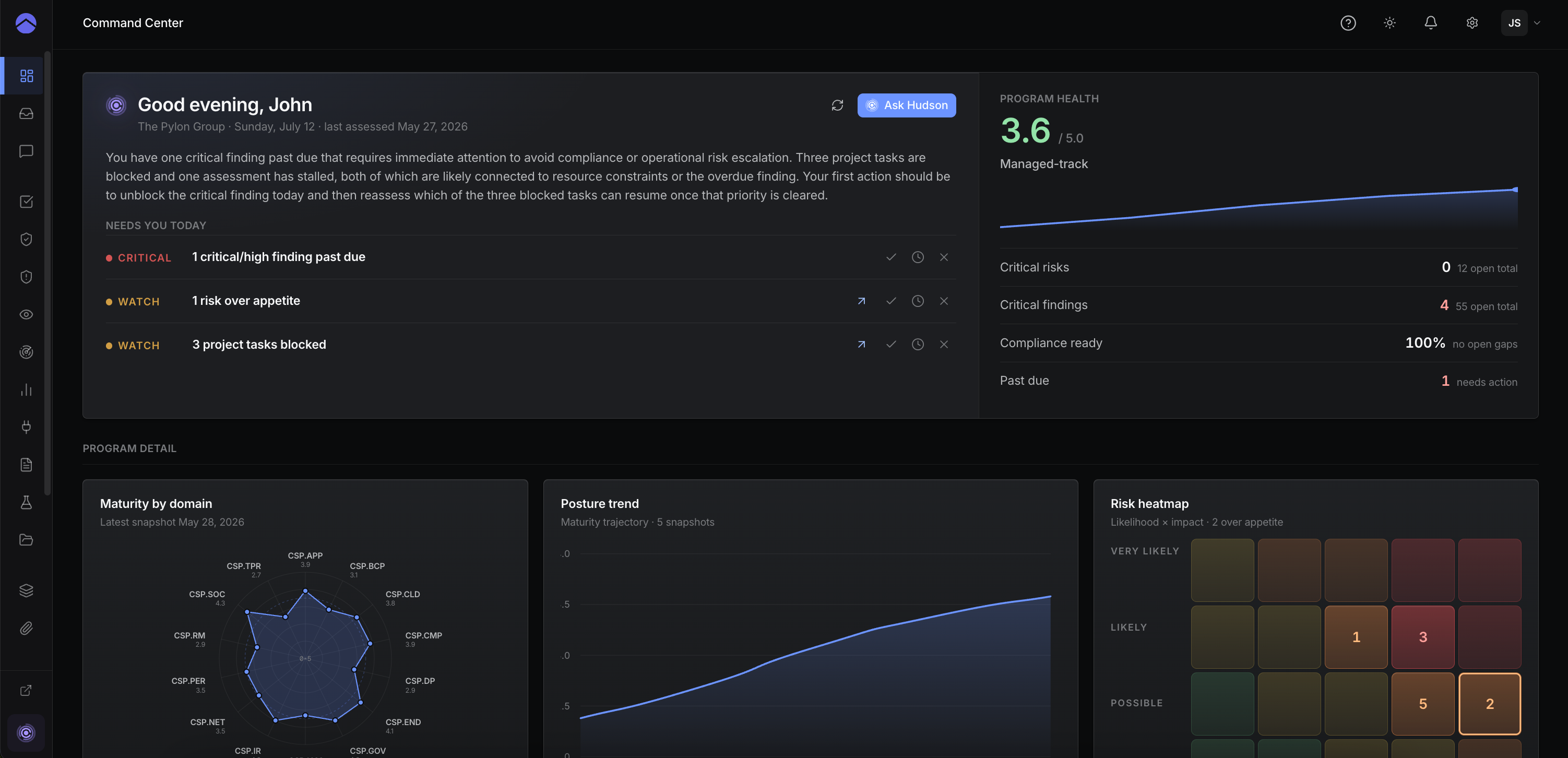
Command › Command CenterProgram healthManaged
3.6/5posture
Identify4.1
Protect3.4
Detect2.6
Respond2.1
The in-house program
One company, one program, one team. The default seat: the loop, the record, and a board brief that is current because it was never assembled by hand.
You are herePractice Console › Client bookClient book11 programs
2need you
NovaPayFintech · SOC 22.8▼ 0.3Needs you
Vireo HealthHealthtech · HIPAA2.4▼ 0.3Needs you
LoomyardSaaS · ISO 270013.9▲ 0.2Healthy
Cedar TrustBanking · CIS v83.2▲ 0.3Healthy
The vCISO practice
A dozen clients, one console. Every program's maturity, trend and open criticals side by side, sorted so the client who needs you today is already at the top.
For vCISO practices →Portfolio › ScorecardPortfolio scorecard9 companies
3critical
Meridian HealthHealthcare · 340 staffC▼ 0.22 critical
Harborline LogisticsLogistics · 1,100 staffB▲ 0.40 critical
Arbor Dental GroupDental · 62 sitesC▲ 0.11 critical
Kestrel ManufacturingIndustrial · 780 staffB▲ 0.20 critical
The PE portfolio
Every holding on one scorecard. Each company runs its own program; you see all of them, and the portfolio security deck builds itself on demand.
For PE portfolios →§ 05Next
See it on
your own program.
Bring a framework you are held to and a finding you have been carrying. We will walk the loop with your material, not a demo tenant.